Sprinkled Harmattan
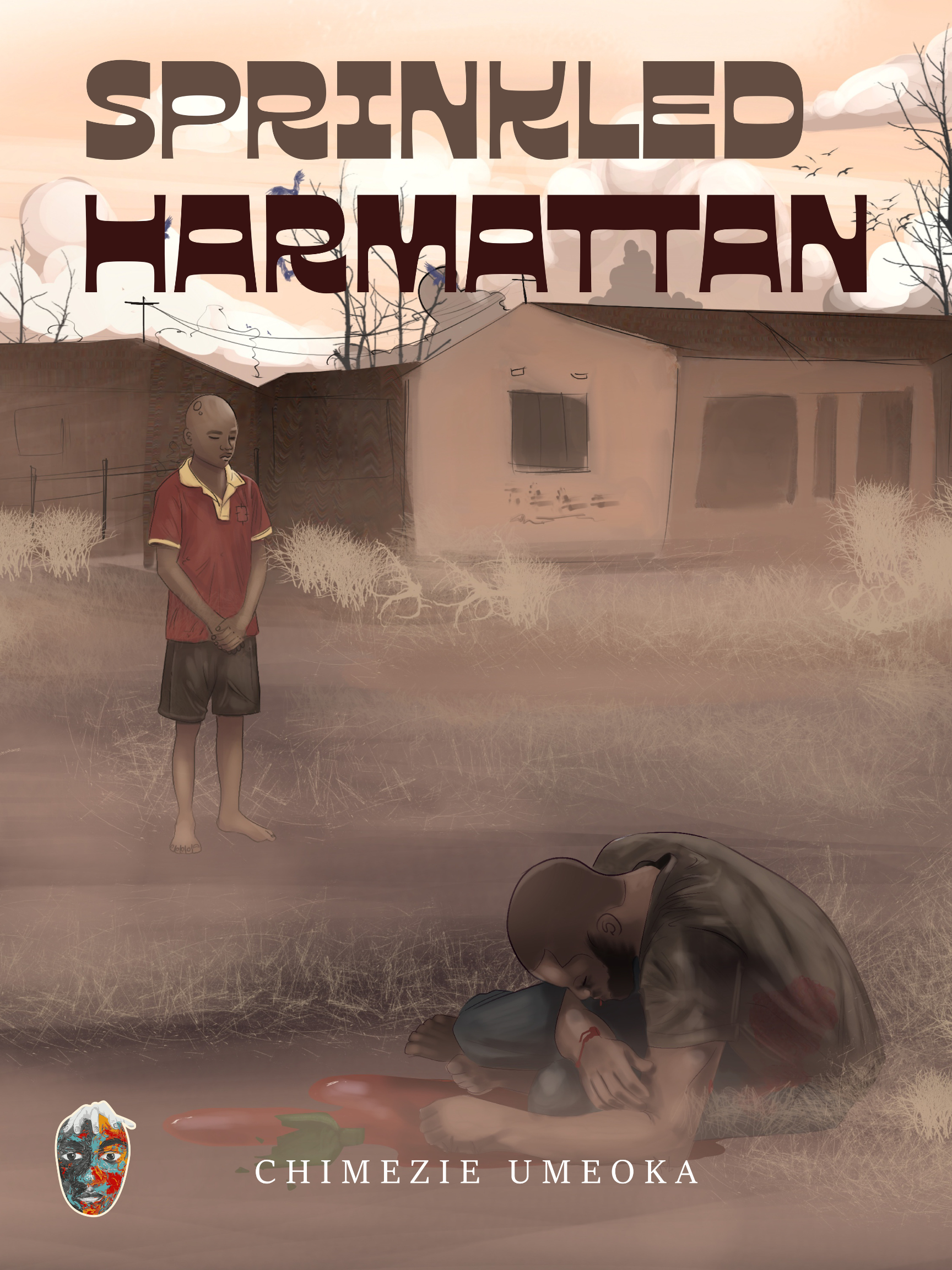
Everything was dry. Like a desert rendered to an eternal lack of rainfall. Everything was dry; crusty whiteness defiled the naked skin of the children in our street. The roofs seated low before my eyes were covered in a thick coat of dust. The grounds of our yard were clean and the moss-speckled holes forged in the splattering of rain drops left pockmarks under my feet. The green rug inside our room raised dust when we walked and grew denser whenever we swept it with a broom. This dust would perch on our netted window, inside our empty pots, so that Edu, my younger brother, complained incessantly about how he had to rinse the pots repeatedly whenever Mama wanted to cook.
This dust dwells in the memory of my breath, so that after these five harmattan seasons, I still remember the acute smell of the dryness suspended in our small, dark room that never bore light during the day. Our passageway was too enclosed and distant from the creaking door that led to a column of single rooms of which ours was the last. I still remember this dryness: this dryness that was sprinkled into our small lives, into my own fragile life and how it sealed my lips, numbed my bones so that when that doomed war broke out, I became Kevin Carter, photographing the images through the lens of my itching eyes, and saving them in the hard drive of my mind. Except I am a bit different from Carter, because while the most important image he took was that of a pot-bellied child ridden with hunger and dying of helplessness, to the patient waiting of the Sudanese vulture[s], mine was that of Chibuenyi, my elder brother, as he lay like a bloodied sparrow to the predatory gyrations of our yard people.
The genealogy of everything began with Damirida, our neighbor who lived next door, and whose crazy lifestyle, enhanced by his sacrilegious stereo, caused a major change in our lives in the descending evening of that distant Tuesday. Damirida’s stereo was life-sized, charged with two enormous speakers that boomed to the thickness of his highlife songs. In the very peaceful beginnings, when we were the new neighbors, my brothers and I would always sneak into his room, and would sprawl below his Plasma TV and electronic sets connected in a quagmire of wires to a long socket. He loved watching video tapes of highlife musicians; prominent amongst them was the condescending Ayaka Ozubulu and Mama’s personal maverick, Osita Osadebe. We loved the loudness of his speaker, the stuffiness of his small room, and the enormous visions of his TV. And we existed in seeming peace, like the beginnings of most relationships.
That evening, Mama had returned home from work tired. She just had her bath and her body was still wet with droplets of water, as she lay on our bed which was ridden with patches. There was no light. She had opened the windows, drawing the net over the empty square because mosquitoes roamed and their vibrant buzzing was unpleasant to her ears. Mama had said to me, “I need complete silence, bikokwa,” and I nodded from the corner where I sat, alone. Chibuenyi had not returned from the Terminus hotel where he worked, and Edu was at the nearby Block Rosary center—a place where the Roman Catholics, especially young people, gather at evenings to pray and beseech on the Blessed Virgin Mary to intercede on their behalf. I never attended with Edu because the treachery of patience that was required for praying twenty decades of the rosary was too demanding for me. So I remained tucked at that corner, beside the conglomerates of pots and plates, as Mama rested during this sacred moment of hers. It was for behaviors like this that they called me ogbanje. I was just not cut out for the benevolence of religion.
It was sudden when at this time, the small bulb in our ceiling threw flickers of yellow light across the walls of our room. The NEPA people had restored power, sending waves of jubilations across our street, as the many children began shouting UP NEPA! UP NEPA! and drumming on things incessantly. It came with great jubilation because our transformer had blown some six months ago, rendering us in perpetual darkness so that the coming of this new light felt like redemption, like the prophetic light at the end of the tunnel, at least for the occupiers of the broken homes in our street. And not for Mama, because just then, with her unconsciously surviving the animistic outcry of the children, Damirida’s speaker leaped into the air with an erratic loudness, into Mama’s sacred, sleeping moment. It was so loud, louder than it has ever been. And to crown the sacrilege, the children in our yard began dancing to the song—One Corner by Patapaa—which was trending in the whole of Nigeria. The noise was cataclysmic, cutting through the night, piercing the humble solitude that hung in our room like spider webs. Mama woke up with a shudder, her face masked with sleep marks, as she asked, “Ngịnị na eme, what is happening?” Words were in my mouth when she realized what had happened. She sent me to tell Damirida to reduce the volume of his speaker. Something heavy hung in my chest, a halo of tension sprang above my head, because before now, long before this night, there had been a rift in our relationship with him. The seed of this rift was not planted by Damirida. It was something bigger than him. It was planted by our landlady.
*
Our landlady called Mama Agwu. Mama called her Busu, or evil cat. Our landlady said that since we moved in, she has been having capricious dreams and her progress has been receding. Mama believed that the cause of Edu’s illness, of the dry scabs of flesh scalding from his skin, was our landlady eating his flesh from the spiritual world. Our landlady said Chibuenyi would be useless. Mama laughed in referral to our landlady’s son, saying that while Chibuenyi’s uselessness was a prophecy that was doomed to fail, hers was already a complete embodiment of uselessness. Our landlady’s son, Aboy, smoked and had dreadlocks that hid his eyes, so it was easy, given the stereotypes of our existence, of which I used to uphold, to discern who was useless. And truly, it was not my brother, for Chibuenyi was my personal aficionado. We called him Frank-Edwards-Aba-Branch, because in the sunlit backyard of our home during our much younger years, when life was bliss and melody, he would sit on the pavement singing songs by the popular gospel musician, his voice traversing high pitches that rang throughout the neighborhood. Later, at nights, charmed by the magnificence of the starlit heavens, we would share dreams of him becoming an established musician and me a writer. We no longer dreamed those dreams. We only dreamed of survival.
These abusive remittances of our Landlady and Mama were not shared face to face. They were disseminated by the postal skills of Edu and the younger children of our Landlady who were mates. In our verandah, a public outer space in the front house shared by the entire neighbors, I would always overhear them playfully bashing themselves with insults. These insults were morphed into uncensored statements like: “My mommy say your mommy is witch.” “My mommy say your mommy have wings that she buy from Indian dibia.” “My mommy say your mommy is busu.” “My mommy say your mommy is osu.” Until one day, Edu returned with tears streaming down his cheeks and when Mama asked him why, he said that someone had told him that “my mommy say your daddy run away because your mommy is ashawo.” It was then that Mama initiated the convention that we ostracize ourselves from the entire neighbors because according to her, onye ndị iro gbara gburugburu n’eji ogologo ngaji eri nri. The one who is surrounded by enemies in a feast eats with the longest spoon.
So as I sauntered to Damirida’s room that night, I let my eyes linger on the sticker on his door. It read, My Year of Financial Resourcefulness. I still remember the one from last year, the one Mama had said he got from one of those peevish pastors who fed on people’s ignorance. Mama said those pastors, instead of blessing their faithfuls, took away the blessings that were already in them. Mama believed that the evil being perpetrated under the guise of religion was far greater than the good, and that this evil was directly conferred by the placement of hands on one’s head. So for a long time, so long that I no longer remember when it began, Mama would use her thumb, dipped in a bottle of Gova olive oil, to enunciate the sign of the cross on our forehead every morning. It was this sign that would keep us protected against all evils that lurked around our world, which resided under the palms of evil people.
“Onye, who is that?” Damirida asked as he opened the door; his large face bearing down on me.
“My mummy said you should reduce the volume, biko,” I said, entirely in Igbo.
He stared at me for some time, then he disappeared behind the door, jamming it to my face. I listened to hear if the volume was being reduced, because whatever I had to tell Mama when I got back had to be definite. Instead, I began to hear Damirida’s foot stamping to the rhythms of the song, his voice rocketing alongside the lyrics. I sneaked back into our room, but there, it was not the Mama that lay on our bed with the sheen plaster of otherworldly gentleness on her face that I saw. It was not the Mama that was given to the undoing of her sacred moment. Mama’s arms were flaking to the fast-paced strapping of her bra, to the pulling up of her tights and to the packing of her hair in one assemblage of unity. The ceiling fan above our head whirred with laziness, and it was the scathing sound that hung in our room after Mama jammed the door behind her.
I followed Mama as she stormed into Damirida’s room. He was bare-bodied except for a small piece of cotton boxers that elevated the bulge between his legs. She began unplugging every sort of wire she could find, yanking at them with such ferocity that some of the small gadgets sailed in the air. Soon, her hand tampered with the right connection as the maddening sound of the speaker quenched with the backdrop of a distilled piercing lingering in my ear. Damirida sat looking at her, his face a display of confusion flamed by surprise. Mama left the room dragging me alongside her. For those first few minutes when we were back in our room, Mama and I were vaguely sure about something. As my heart heaved with tension, colliding with the stamping of Mama’s foot on our rug, I began to recite the Hail Mary in my mind. It was easier to let those words fill the corridors of my head than to let my thoughts abseil like a kite to the cyclonic fear that hovered in our room.
“Whatever happens, listen, I want you to stay inside here, never come outside, Inukwa? I don’t ever want to see you cry,” Mama said, a bulb of tears glowing in her eyes.
Now this is the thing with my mother; she is like the wind. Mama was never the kind to be seen exhibiting the mad exchange of words like most women in our neighborhood. For as long as I can remember, Mama was the silent kind, but like the gentle rising of the wind, she could plunge headlong into a war with such agility I believe, is beyond the powers of this world. With every action that affected us, her children, in any way, Mama would ascend into her avatar state. We were like her fail-safe button. Mama would always tell everyone that it is better she kills one of us than for an outsider to give us the thinnest map of a wound. So as I sat in that room, beckoning on the same Virgin Mary that I had rejected, I hoped that this would be one of those occasions when with great tension I sleep off, only to wake up to a morning blessed with a new order of resolve in the form of the rising of the eastern sun and the overwhelming blueness of the world.
*
It was not the knocking on our door that elevated the suspense. It was the volume of different voices all culminating into one premonition of war that alerted our antennae. Our weak door was locked. It shook vigorously when the people outside began to knock harder. I heard the ear-troubling screech of nails simmering out of the rusted bolt before Mama finally stood and opened the door. She jammed it behind her and in whatever way she did it, she led the voices farther away so that it faded from my hearing. I could only hear it in dimming slashes.
In those few minutes I was alone inside our room, the walls felt like they were pressing together towards me. The green paint loomed with such mystification that I felt the same way I used to, when in the rural outspace of our former home, my brothers and I would turn and turn until we were toppling to the drunken reactions of gravity.
In the assessment of my kinship to Kevin Carter these five years later, I realized that in those minutes, inspired by the voices of our yard people which had grown louder and threatening, I could have rushed out to save my mother from whatever had become of her. But my legs felt heavy, my soul brimmed with anxiety. The same way Carter was numbed of his ability to save a dying boy from the malevolence of hunger.
It was Edu that emerged as a figure on the doorpost minutes later. The NEPA had taken the light now, so in the sinister darkness, his rosary glowed in such immaculate radiance reminiscent of a full moon hanging in the sky. “They are beating mommy, they are killing her!” He yelled at me as he disappeared through the passageway. My feet were boiling with the numb effect as I followed suit, using the tight wall as a guide through the darkness.
Inside our compound, I saw a group of people bent over Mama. It was Damirida, Aboy and our landlady’s two daughters all punching the figure below their convergence. Yet, the figure below was not daunted by the enemies above her. She held onto their strands of hair. Edu, as weak as he was, was frailly beating Aboy from behind, but in my experience of many street fights, you could be knifing someone and to them, bewitched by the spasms of violence, they would only feel it as a gentle tugging. In the sickness of my mind, I ran to the kitchen to fetch a bowl of water so I could pour on them. It was not only the thought of a mad man, but one who had been christened by the madness of the whole world. Before I could return, Chibuenyi had entered through the gate of our compound, and on beholding the figure teetering below her enemies, the figure that was our mother, he—as herculean as he was—began to throw them off like the cartons of noodles he used to throw from rooftops when he still worked as an errand boy in one of the popular markets. His strength, inspired by passion, was unmatched. In one swift flex, he had given Aboy one energized punch that sent him staggering. Mama gained the chance of a one-on-one duel with our landlady. Like a ferocious dog, she fell her to the ground and began to tear her clothes as the woman wailed with all the vocal cords in her. Damirida had long escaped on sighting Chibuenyi.
Everyone in our vicinity knew that Chibuenyi was a calm beast. Once, he had beaten a thief to a pulp in the middle of the night, after the thief, armed with a hook-like equipment, had tried to steal Mama’s purse from the window of our room. It was the incident that brought the local security men the next day, offering Chibuenyi the chance to work with them every night. Chibuenyi, my talented brother, joined the local security that night. Something that became a stigma to our purple, childhood dreams.
Our brief victory began to climax when Aboy, creeping through the darkness permitted by the impermanence of NEPA, began approaching Chibuenyi. From the angle of our passageway where I stood, I saw a bottle jarred into a weapon glistening in his right hand. I wanted to yell. I had the chance to alert my brother. But too much air filled my mouth so that what came out was not definite. It was a shrill wail that instead of alarming Chibuenyi, diverted his attention to me. Aboy tried to punch his stomach, but my brother, in a late escape attempt, got it stuck in his right arm. Aboy pulled and struck again. It sank into Chibuenyi’s lap. He pulled and struck, again and again—into the receptive flesh of my brother—as though the blood that had begun pumping out was not enough spectacle for him. My brother fell to the ground as he groaned in pain. Aboy jolted from his crime spasm and ran away. Chibuenyi's soulful cry weakened Mama. The sight of blood pumping from his mangled existence destroyed her. And as she walked towards him, the recurrent incantation in her mouth was, Nwam, what has happened to you?
With the sight of too much blood, everyone in our yard, including our landlady and her allies surrounded Chibuenyi. Edu fainted beside him, so that Mama’s questioning cry of despair took the plural form to become, Umum, what has happened to you people? Even now that I think of it, Mama’s cry felt more personal to me. It was beyond the meaning cast by the perforated body of Chibuenyi and the still, frozen body of Edu. It was a question to me, to my stillness, to my undoing approach to life in the most essential of times. It felt like a voice from my future: Nwam, what has happened to you?
Before the crowd before us, we felt like we were lying in a desert, like a small pot-bellied child ridden with the hunger of food and pain and blood and war. And the many searching eyes above us felt like flashing cameras. It was this image, this helpless image given to the waiting of the vultures above us that would haunt me throughout the following days and in the next five years.
*
Mama used to tell us that the devil strikes with passion. That there would be a time when everything, every bad thing will unfold in continuous order that one would begin to question if some hell of ill luck had been let loose. She believed too, that the devil was not the ferocious, elf-like, sent-down-from-heaven beast we regarded him as, but that the devil was an emotion, an evil thought ingrained in the hearts of people willing to accommodate it. To illustrate her analysis, she would break down the Igbo word for Satan—Ekwensu—into two syllabic units, saying that Ekwe meant to consent, to agree, while Nsu meant to strike, or be stricken. So in the great etymological ambitions of our ancestors, the word had been coined to explain for the intrinsic capabilities of man to accommodate evil, and in the ability of that evil to transmute into a tragedian manifestation. But that in the vague tainting of the white man’s doctrine, and an unconscious lack of history, we have forgotten what our own words mean, that we now suffer the consequences of not knowing.
From the verandah of the hospital, the large expanse of farmlands withered to the scorch of Harmattan. The soft winds grazed over the pines of dust-coated grasses as they flayed to its rhythm. The soulful cry from a distant church danced in my ear. I could only hear Chibuenyi’s shrill, hurting cry in whispers. We were brought to the hospital by one of Mama’s friends who lived opposite us in his Keke. The man had driven along the pot-hole filled roads with such madness that my head bumped and hit the metal railings. I had held Chibuenyi’s legs from which blood trickled like oil migrating from the gentle soul of a Niger earth. In the raze of that photographic moment, our landlady who was a retired nurse had tied his hands and legs with a piece of white clothing so that the tap-rush of blood was reduced to a trickling mildness. Yet Chibuenyi was full of blood. The clots mapped his skin. And he grew hotter in my hands, as we plowed through the roads to the hospital in a night full of maddening anxiety.
The doctor, a very young man who was quite ordinary except for the clean radiance of his bald head, was assisted by two female nurses as he stitched Chibuenyi’s skin. He had told Mama, after she came later that night, that if we had wasted a bit more time, or that if he had gone on with his second instinct of not sleeping over the night in the hospital, Chibuenyi would have been a dead thing. He called him thing in an evasive manner, something that was naturally inconsequential, yet sounded offensive to me. It heightened the tension that filled my nostrils in the form of the tight, medicinal smell of the hospital. It made me afraid that Chibuenyi would be different. That some part of him can never be revived. My mind was blurred, yet the occasions of the night flashed across my mind in blending snapshots. It felt like I was seeing a film flickering with images of dead people, the kind we used to watch on the BBC channel. Of impoverished Somalians and Sudanese refugees and remnants of the Rwandan genocide victims. Chibuenyi felt like a half-dead person to me. My Brother, whose muscles I admired, whose ripped body gave him finesse, whose voice flowered the silence of my life, was now slimmer and his voice was croaky like the scratching of paper.
As he lay on the single foam suspended by an iron bed stand, I could see how the hairs on his lap smeared against his skin with the wetness of blood. The doctor let us see him once after the stitching, especially for Edu who was now awake and crying. Mama held our hands as we stood before him, singing in tears. She told me to pray after we had sung for a long time. The words of my prayer felt bland and tasteless in my mouth. It felt like a recitation; like an anthem, and when I stopped short and began stammering, Mama continued from where I stopped. Later, she kissed me on the forehead and told me that Chibuenyi was proud of me.
Chibuenyi was proud of me, beyond my fears, beyond my anxiety. I was covered by the silhouette of our love. I was preserved from the dangers of the war, yet I was treated as though I was a victim of the tragedy. Throughout the days we spent at the hospital, my brothers and I reveled in the most brotherly of our days. The hospital became our temporary home. The doctor was kind enough to lease Mama an empty room—initially used as a parking store—for our purpose. And after some of our properties had been hand-picked into it, Chibuenyi was moved. The bed he lay on was suspended by a metal stand, the kind that had springs that squeaked beneath it. The hospital was different—open, and receptive to foreign intrusions. Mama said we would stay here till she was done with all her Police inquiries. She had been visiting the Police station at Bakasi road since the incident, and everyday she would tell of how uninterested the police officers were with her, because she could not bribe them with money. It was hard, watching Mama hoping to redeem herself, to find justice for us. Watching her was a kind of after-war experience. The toll became more visible on her with each passing day. Her face grew shadows the colour of dead mushrooms. Once, when she was about to take her bath, as she removed her clothes to change into a wrapper, I saw how longer and more visible the stretch marks below her armpit had become. Even her nipples became darker, as though dark nubs were the bodily reaction to trauma.
The night before I made the decision, we were making jokes about our younger lives. Chibuenyi spoke the loudest, we gave him time to speak because we loved the confidence of his voice, and above all, we loved to cling to it as a sign of his redemption. As he was speaking, his cellphone which lay close to him began to ring. And for a while he continued to speak as though he wanted to ignore it, as his voice permeated over the sound of Lee Lee—a song by Resonance which was his ringtone. He picked it up later and after a brief moment of silence, he said to me, “Papa called.”
A croaky voice was still resounding from the speaker when he took the phone and plunged it into the 65 litre drum of water that sat close to the opposite wall. The drowning sound was hollow. I imagined the black mobile deepening into the dark waters, the way the Titanic sank; and this memory would etch into the reconnaissance of my mind these five years later, so that I now attribute water as resistance. And it was water—a promise of eternal freshness for my troubled life—that I hoped to serve as conduit to my pacification.
“Onyema,” my brother called me, his voice suddenly calm, suddenly whole. “You know the nurse that treated me? She was so beautiful, so rounded. And…” he glanced at me, his face radiating with bemusement. “It took so much will and power for my penis not to stand. Amu m chọọ ike.”
I burst into a vibrant laughter. He joined me. I remembered the nurse who had treated him alongside the doctor. I remembered how his penis folded in a bulge against his short Chelsea-strap underwear—the only thing he wore so the wounds could be accessible. Our nude skin collided as we laughed and I could feel the watery plaster of sweat on his skin rubbing off on mine. His yellow teeth glistened in the faint darkness of the room. He held my hands, looked directly into my eyes, and I could see how much his eyes had yellowed from the contrast of its whiteness of our blistering childhood days. In his eyes, I could see a lining of vigorous hope.
“We will survive,” he said, “and one day all these will just be a story you will tell.”
The way he spoke of the future made me hopeful. I could dream of the future which he spoke about. It opened up in my imaginations as a desertified landscape. A distant future decorated by an unfamiliar life. It was distant, yet close. Invisible, yet plausible. This future was possible for my mother, and for my brothers, whose lives had been sprinkled by undeserving dryness. I could feel it in them, in their bones. This future was possible because someday the rains would come, and all dry things would be remembered in watery salvation. But there are some of us who, even with the rains, cannot forget what happened during the seasons of dryness. We are the things the saharan wind comes to blow out into oblivion. Kevin Carter knew this and walked into the certainty of that faith. It took me five years, five unresting years to understand I was not a partaker of that future.
I am used to taking casual walks very close to the mouth of the lagoon these days. It is the fifth harmattan season, and everything is dry again. It is a whole new place, but the dust is still here. It is not above the roofs like five years ago. The dust is suspended above the water. It holds the face of remembrance. The water holds the gaze of black eternities.