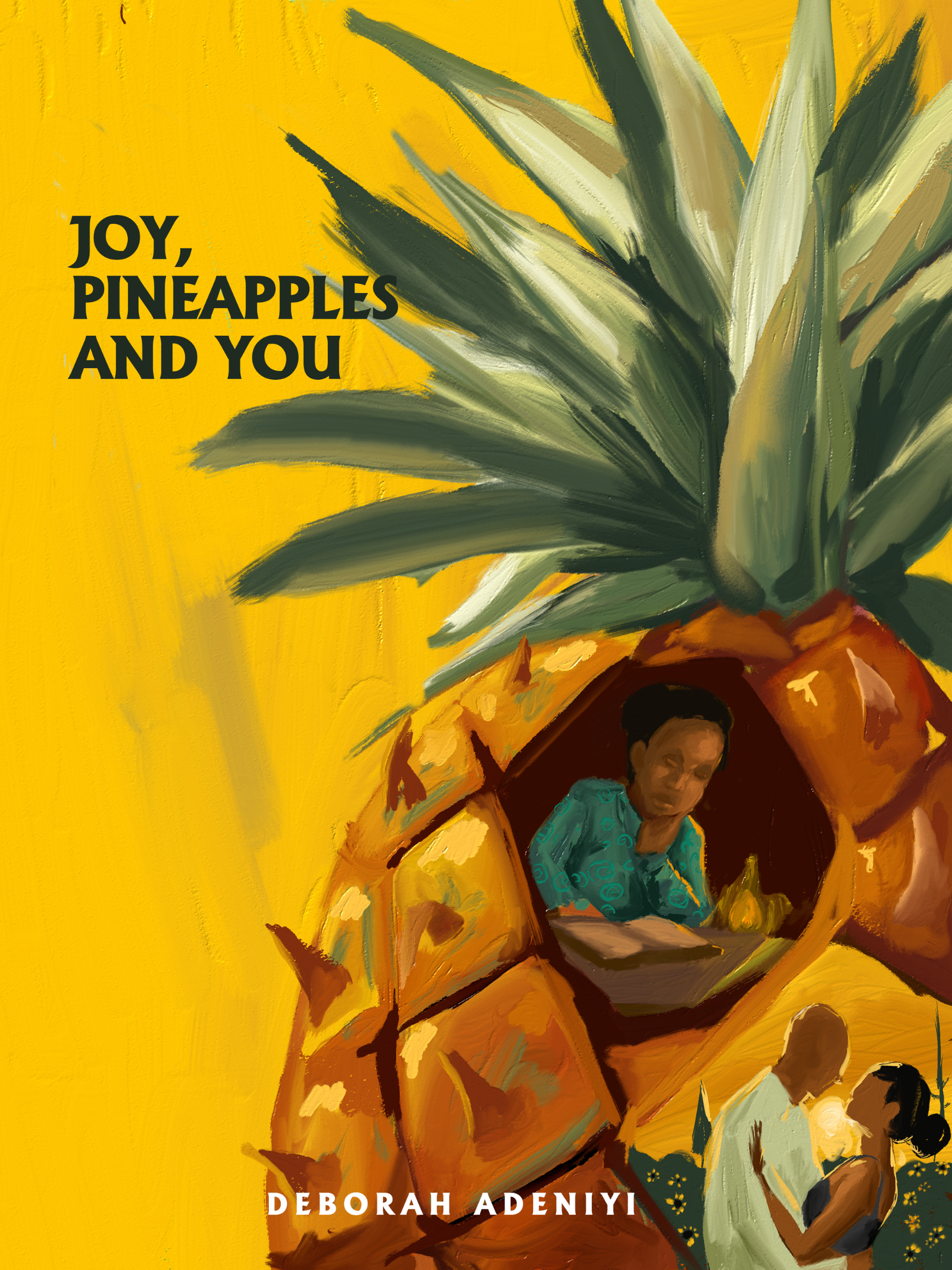
Joy, Pineapples and you
I.
Joy smells like pineapple. Every time you inhale the cool evening breeze, you feel a sweet taste on your tongue. You're in a temporal space, away from Ibadan and your lacklustre life. For even as you savour this feeling, dopamine and lightheadedness, a part of you knows this will end too, just like every good thing in your life. But for now, you let this man with his tender voice, boisterous laughter and calming presence call you Baby, and the identical girls call you Mama.
“I missed you, baby. How was your trip?” His arms brush yours casually and your treacherous body responds, tingling. “I can't wait for the girls to sleep. We have so much to talk about.” His eyes wink at you with promise, and your eyes imitate the action in reflex. If you are Baby, then he must be Ife, the love of your life.
“Mama, see my hair!”
“Mama, please, please, make puff-puff for us.”
“No, make pancakes, please, please.”
“No. Mama, she drank from her seatmate’s bottle! Puff-puff! Puff-puff!”
One of the girls says and you all burst into laughter, your eyes twinkling, your voices musical. You believe she must have gotten her wit from you.
You find it easy to slip into this beautiful chaos, like how you slip into your adire bubu everyday of the week. You start first, by caressing your husband’s arm. Lol, husband! Look at you! Second, by answering the girls and praising their hairdos. From their endless chatter and nagging demand for attention, you peg your daughters' age to be seven.
In this place, you can be anything. Nothing is familiar even though everything feels right. Ife picks your bag and shoos the girls into a waiting Venza, just like the one in your garage at home. All through the ride home, his hands are entwined with yours and you flash dreamy smiles at each other, blocking out the prattling of the twins, inhaling joy and pineapples.
II.
Unlovable, old, sad, rich, and lonely. These were the words you threw at your therapist when you liked yourself enough to seek help five years ago. Every morning your eyes pop open five minutes before your alarm goes off and you sit in the emptiness of your apartment, asking yourself questions that end in tears and start your day with glum. In the generous five minutes before your alarm dings, you find yourself questioning life and the whole concept of existence.
You consider not ever waking up and the bliss that should come with oblivion, but you remind yourself that you are not that brave. If you try to take your life, you will fail miserably and end up in the hospital. You don't love yourself enough to end this suffering you call living. If you had a choice, you'd have nothing to do with yourself.
Driving to work is always an experience for you. You love the roadside drama: an agbo seller holding a man by his waistband to pay up his debt, a bus driver zooming off with a passenger's change. Hawkers creating a melodious orchestra as they call on buyers. It feels like you're in a cinema watching life unfold before you. Jericho to Agodi is only about fifteen minutes, but you tell your driver to always go through Jericho, Eleyele, Sango, UI, Ojoo Express way, General Gas, Iwo-Road, Idi-Ape, Agodi.
The wind stirs, inviting acrid smells from the roadside gutters into the car. You tell your driver, Mr John, to wind up the window. Today will be a boring day, no drama. The other day, it was some yahoo boys bathing by the roadside. Another time, a scuffle between a driver and a uniformed man. On several occasions, you've witnessed raw elation in the form of wedding convoys, roadside love, cultural displays and festivals. These sightings, as mundane as they appear, are the highlights of your day. You recline against the chair and close your eyes to sleep when Mr John's phone rings. From the ringtone, you know it is his wife. A long horn blares from an approaching oil tanker and you sit up; unless this potential accident promises to kill you on the spot, you want nothing to do with it. Better safe than maimed.
“Mr John, park.” Your voice sounds strange to your ears, cold and grating, like grinding glass bottles in a blender.
When did you become like this? You faintly remember being popular in the university, actually living and looking forward to the sunrise. Now, a candle has gone off inside you, and you're plunged into absolute darkness.
“Yes, ma!” He listens for a while, nodding with excitement as if encouraging her to keep talking. You catch a smile on his face through the rearview mirror.
"Praise God!!! Two? Noooo! Boys? Jesus!"
The call ends after he asks which hospital she is in, with a promise to visit her right now!
Mr John turns to you with a look you have never seen him wear. Assertive and defying. You are sure that if you disagree with him, he could resign on the spot—damn you and your competitive salary. Because you don't know how to drive, you clear your throat and say, “Let’s go to the hospital. It's Friday anyway, orders have been sent out yesterday.”
It's Friday and it's your birthday too, but nobody remembers.
Your mother will video call you via WhatsApp by 2pm when your sister returns from school. You will not laugh or loosen up. You will accept their prayers and wishes, watch them cut the cake and feed the camera, with a detached look. You will read their smile as cautious and uncertain and it will make you wish they never called in the first place. You scroll through your call log to see if you’ve missed any calls, if any of your old friends reached out. You find it empty, and worse, you’ve only ever had calls from your mother, staff or your service providers.
At the reception while you wait for the new mother to be cleaned up, you see a little girl curled in her mother's lap and you wonder if you will ever feel this attachment with or to anybody. Everything around you seems to mock your situation; every laughter seems too loud, every stare, too long, every greeting too performative. There's laughter, connection, love all around the tiny space of the reception, but you feel nothing.
Mr John's sister pokes her head out of the ward, and with a cherry smile, says, “Brother, you can come in now.”
You watch her smile falter, hanging like an ill-fitting shirt as soon as her eyes fall on you. You stand taller and walk stiffly down the hall. This should be as brief as possible.
Whoever said the eye is the window to the soul must have seen something through another person’s eyes. Unbridled love? Uncontained hate, maybe. As you step into the ward and smile at Mr John's wife, her window flings open and you find a full-length mirror staring back at you. When you stretch your lips into what you believe is a congratulatory smile, her smile slips and through her brown iris window, you see you have only managed to produce a scowl.
“Congratulations, Madam, may God watch over the children.”
“Amen. Thank you, may yours come too.”
You nod and escape the ward. You leave a message for Mr John that he can keep the car until tomorrow morning. You'll order a ride to the office.
III.
Everything in you says not to open the box, delivered by a dispatch rider who asked for you by your full name. Just as it is arranged on your BVN, NIN and birth certificate. You knew, even as you shut your office door and told your staff not to disturb you, that opening this box was madness. You undo the fancy ribbon and even though you are not sure what to expect, you have to admit that its content is disappointing. A black book with tiny lettering, you have to squint and hold it up to the light to see. Whoever is playing a prank on you doesn't know you; you lack the ability to receive a joke or be teased.
You flip through the pages, disgusted but curious and you sit back as a menagerie of images flash through your mind’s eyes. Images you have never seen flicker as quickly as it takes a page to lie on another. Wunmi, what have you gotten yourself into? You ask yourself, your palms sweaty, your throat dry.
IV.
Ten years ago, you were twenty-eight, your perfume business had just landed a multimillionaire contract. Your wedding was going to bang! Your husband-to-be, Femi, had gone out with his friends on the eve of the wedding to get one last drink with the boys and a drunk truck driver had ground only Femi to mash. When you got the news, you did not react. Your bridal train had surrounded you like ants, hoping to fellowship in your grief. But grief is a personal affair, a uniquely personal one.
You asked to be left alone. The door was opened and they all watched, clustered in the adjoining room, as coldness swallowed you up from your feet to your head. For hours, you sat there, unable to shed a tear for the man who had whispered promises of forever to you. A man for whom you had unfurled the tender petals of your heart. This story was supposed to be perfect. When your back began to ache and your feet began to feel like ice, you stood up, your transition into a breathing statue completely done, and immediately started making calls. You paid vendors, made a post about his demise, sent a broadcast message to all the guests and dismissed everybody.
V.
When you get home that night, the book slips out of your bag as you set to bathe and change. You flip through pages, images like memories flash through your mind again, just like earlier. A wedding, a woman running through a valley of lilies, voices. Overwhelmed, you snap the book shut and escape into the bathroom for a warm bath.
Later, after tossing on your wide bed with no trace of sleep, you pick the book again and start from the first page. You try to make sense of the words, try to adjust your eyes and focus on the almost illegible writing. This is how you sleep off, book in hand, bedside lamp peering into the book.
You jerk awake from a meaningless dream at forty minutes past six. For the first time in ten years, you do not wake five minutes before your alarm goes off. You stretch, satisfied by the crinkling sound your bones make. Your smile startles you as you remember the dream: you were in a new town, holding a house address. You stopped at a bar and you met a man there who kept on filling and refilling your glass as you both talked and laughed. You told him about Femi and he told you about Melissa, his ex wife who had twins for him.
You smile again as you stand before the bathroom mirror, brushing your teeth. A tiny dimple pops out and disappears. You attempt the smile again, in spite of your hangover. Later, after breakfast, you swallow two paracetamol tablets for the headache even though you never take alcohol in real life.
VI.
At work, before mid-day, you manage to upset your foreign suppliers. You mixed up time zones. Your investors and suppliers were on Zoom, waiting for the meeting you scheduled while you holed up in a corner of your office, wrapped in a duvet, reading chapter two of the book because chapter one was the dream, and you and Ife were now a thing.
He takes you home for the first time, and you suspect you're no longer in the office when the voice of your PA rings faintly in your mind. Apparently, you had left Mr John waiting downstairs for hours and refused to pick his calls. How could you? You were helping the twins with Home Work.
Worried, your PA had rushed back to work and together with Mr John and Security, burst into your office. They find you asleep on the couch. They are certain you have passed out. You only jolt awake when they try to take the book from your hands.
VII.
How could something so strange feel so good? Who knew your life could be this exciting? The book follows you everywhere because it is your ticket to Ife's world. Your pass to hear the sound of your laugh, taste his horrible puff-puff and braid the girls’ hair.
The last time you had a fight, it was because he had sold the Venza to buy you a gold watch for your birthday.
“I know, Baby. We were worlds apart when you had your birthday, but I have to.”
“But the car! Why sell the car to get me a present?” You wonder how he is so successful at his business if he makes crazy financial decisions like this.
Even as you pretend to be angry, sweetness crawls up your spine, tickling you. No man has ever done anything for you. Not even Femi, God rest his soul, who was having an affair with your former accountant. He had taken a detour after hanging out with the boys a stone's throw from where you were all lodged for the wedding. And he had walked across the street two blocks away to Simi. It was on his way back that he got into an accident. You weren't supposed to find out, but you had pestered his best man who was supposed to keep an eye on him. With red rimmed eyes, he confessed Femi left to quickly attend to something. You had pieced two and two together, and Simi's resignation/apology letter on your desk on Monday morning confirmed it.
You burst into tears, your heart aching from too much joy. Just like how your tongue bites when you eat too much pineapple. This is something you've always wanted, now you have it. Now you don't know how to behave around it.
“Don't cry, please. Don't you like it? I can sell the house too.”
“Are you mad?” you scream in horror and watch him burst into laughter. You laugh too and fall into his arms, grateful, content, loved. You have not laughed in a long while.
The gold watch is the only accessory you wear to work. You like how it sparkles in the sun. You smile when your staff compliments you with their eyes.
VIII.
You read with an insatiable fever because you enjoy this high feeling. You read slowly because you don't want this book to end. In moments of clarity when your mind is not fuddled with the feel of your husband's touch, children's laughter, you ask yourself what is happening? For how long will this last? You feel your heart race in fear and ecstacy.
IX.
You are sitting in front of the dressing mirror. You blink tears away but your shoulders drop in disagreement. You're losing this battle even before it starts.
The moment he steps out of the bathroom, he senses that something is wrong. Maybe it's his soap or aftershave, but the familiar flavour of pineapple you have come to associate with him wafts around you like a hug. A white towel is fastened around his waist, water drips down his chest and pools at his navel.
“I'm going on a trip,” you say.
“Can we come too?”
You know what he means, but you shake your head. “I'll drop by once in a while, but I can't stay long. Explain to the girls for me.”
This is how you talk sometimes, in cryptic codes and this is enough for you. The last time you had gotten too comfortable, you promised yourself never to be that reckless. It was on a slow Tuesday morning, the weather was yet to make up its mind if it wanted to shower or shine. You had lounged on the bed with your husband, after hours of senseless intimacy.
With your fingers tracing his facial hair, you blurted, “do you know it's a stupid book that got me here? A dispatch rider came to my office to deliver the book as a birthday present. Can you believe that?”
You watched in horror as he seemed to dissipate before your eyes. You notice him growing smaller and smaller, his face twisted in pain as he asked you what you were talking about. Quickly, you chewed your words back and told him you were only joking.
“It's a prank, it's a prank,” you screamed, holding up your hands in surrender.
You both know what the actual prank is, but you will never talk about it. Your mother will arrive in Ibadan on Wednesday with your sister, so you tell him you're travelling. You both nod, understanding that you are both actively involved in pranking each other.
X.
Your mother talks about young brothers in her church who have just returned from the UK for Christmas. It takes every ounce of self control in you not to gloat about Ife, your husband. There's a careful delicateness with which she talks to you, almost as if she is afraid you will clamp up on her. But she doesn't know you're not the same person anymore. You have tasted love. You have Ife now.
You're in the kitchen when your sister mentions to your mother how she's bored and can't find anything to read in this big house. Her favourite TV show won't start until 7 pm, and it's only 4:45 pm.
“Check that book on the dining. I saw your sister reading it earlier and smiling.”
“Really? It must be interesting.”
You do not plan to overreact. You only planned to casually waltz in, snatch the book from her and offer her another one. But you find yourself running, banging doors and screaming at the top of your voice. You push her so hard, she falls and hits her head on the pointy tip of your chair's arm.
As you clutch the book to your chest, breath heaving, teeth clattering, you stare at your sister and the trickling blood at the back of her head, and you wonder if your sister is a butterfly; an easy to kill creature. Only one small push and she's gone. You wonder again if she already had one foot in the other world, and only needed you to shove her other foot in to complete her passage.
XI.
What is pain if it's not a subtle easing into madness. The more the intensity, the higher the probability of running mad. A needle prick, a dog bite, a heartbreak, a heart rending loss, all in ascending order.
You are convinced your heart has been ripped into two; blood should flood everywhere by now. Your unravelling starts in slow conscious movements. You tear off your clothes and run around in circles, screaming at the top of your voice, and you remember, two weeks ago in your kitchen, standing by your gas cooker and boiling water. You wanted something bearably hot, not scathing. So you dip your finger into the kettle and tell yourself, I'll know it's time to put this gas off when my finger cannot stay anymore. Fifteen seconds, thirty seconds and more until you yelp and jump around the kitchen, sucking on your finger throbbing with angry red pain. Just like that morning, your pain has simmered to a boiling point and your mind can no longer stay. As you run around, dodging the police officers, the doctors and your mother, your priority is to escape from this body. To jump out of this boiling kettle, and so you run.
XII.
When you wake up feeling chains on your hands and legs, you know you have been admitted to the psychiatric ward of the hospital. Your sister is at the other side of the building, resting in the mortuary.
You look around for the book and try not to panic. It's been ages since you saw the book. Even as you rushed your sister to the hospital, you had held onto the book. Every second you waste here takes you farther away from your husband and children and you don't like that at all.
The doctor comes in with a nurse. They check your vitals, ask you questions and you give them the answer they want. The truth is, you should not even be here with these other people in the first place. But you know also that when you are accused of madness, don't argue about it. Your sanity will prove itself later. You wave at the kind nurse and hold her stare. You wink thrice and you wait, hopeful.
XIII.
The kind nurse, Rebecca, is an angel. You had pleaded with her when you got a chance to be alone with her. And you broke the first rule of those accused of madness. You said, “see, I am not mad at all o, this is all a misunderstanding. I just need a piece of paper and pen. My children and husband are waiting for me on the other side. Please, help me. I need to see them—if only I can just write. Please, paper and pen.”
Her full lips parted into an understanding smile and she nodded again. You nodded along and ever since that morning, last month, she has been supplying you writing materials everyday. She folds it carefully under her tray when she brings you medicine and water.
And you have been writing everything you remember. Sometimes, you get flashes of Ife and the girls. Other times, you get nothing. But one thing is certain, you will not stop, even if you have to write on the pristine white walls of your room, you will not stop until you see Ife and he calls you Baby again.